Yunqing Zhao

Research Scientist at TikTok / ByteDance, Singapore, working on multimodal AI, with a focus on scalable post-training for vision-language models.

PhD (Outstanding Thesis Award) from SUTD, 2024. Previously at Sea AI Lab, Microsoft Research Asia, and ByteDance AI Lab.

Yunqing Zhao

News

2026-02
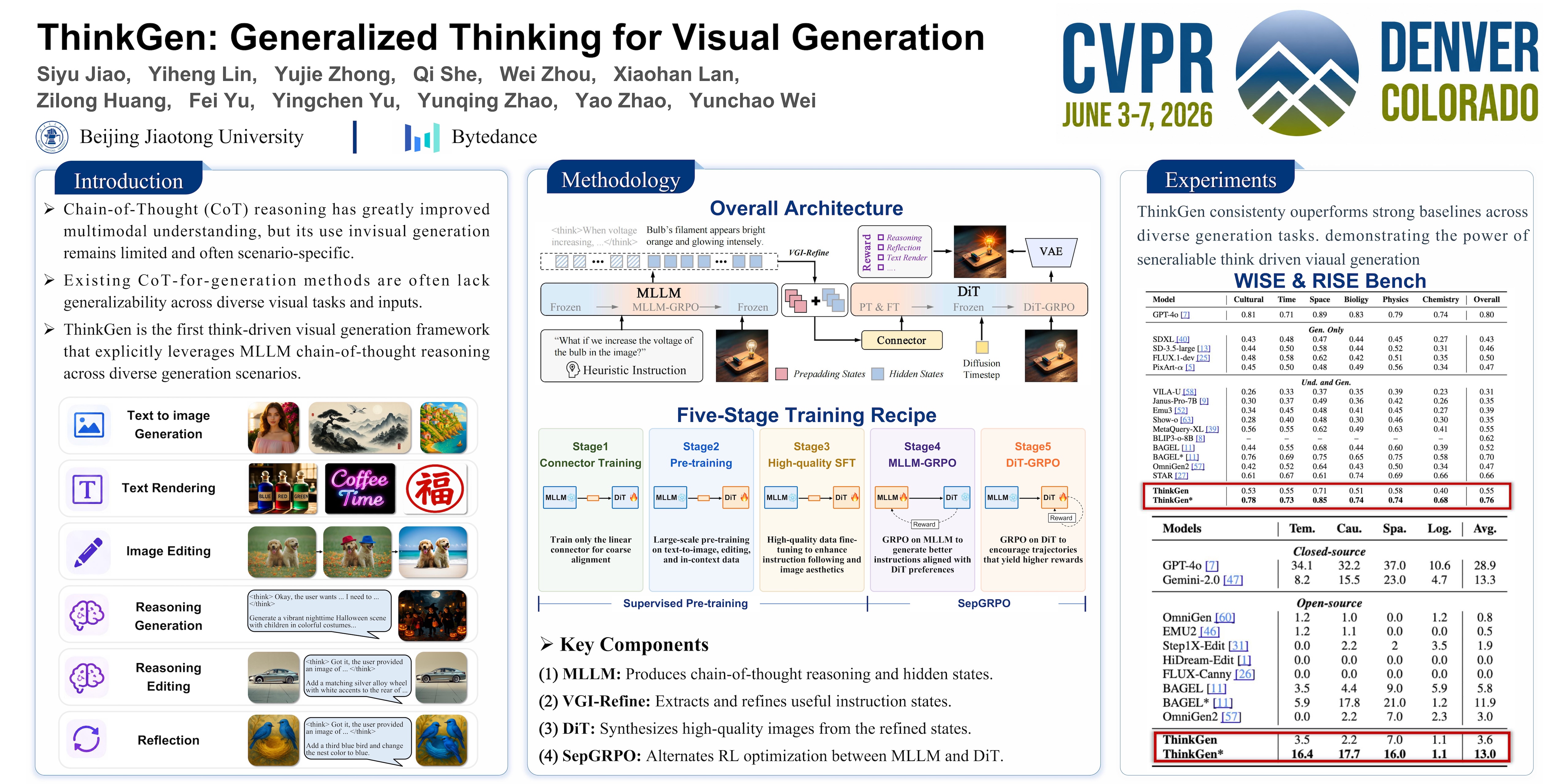
CodeDance and ThinkGen accepted at CVPR 2026.
2026-01
RoSE accepted at ICLR 2026 Oral
2025-08
PhD thesis selected as Outstanding Thesis Award winner.
2025-07
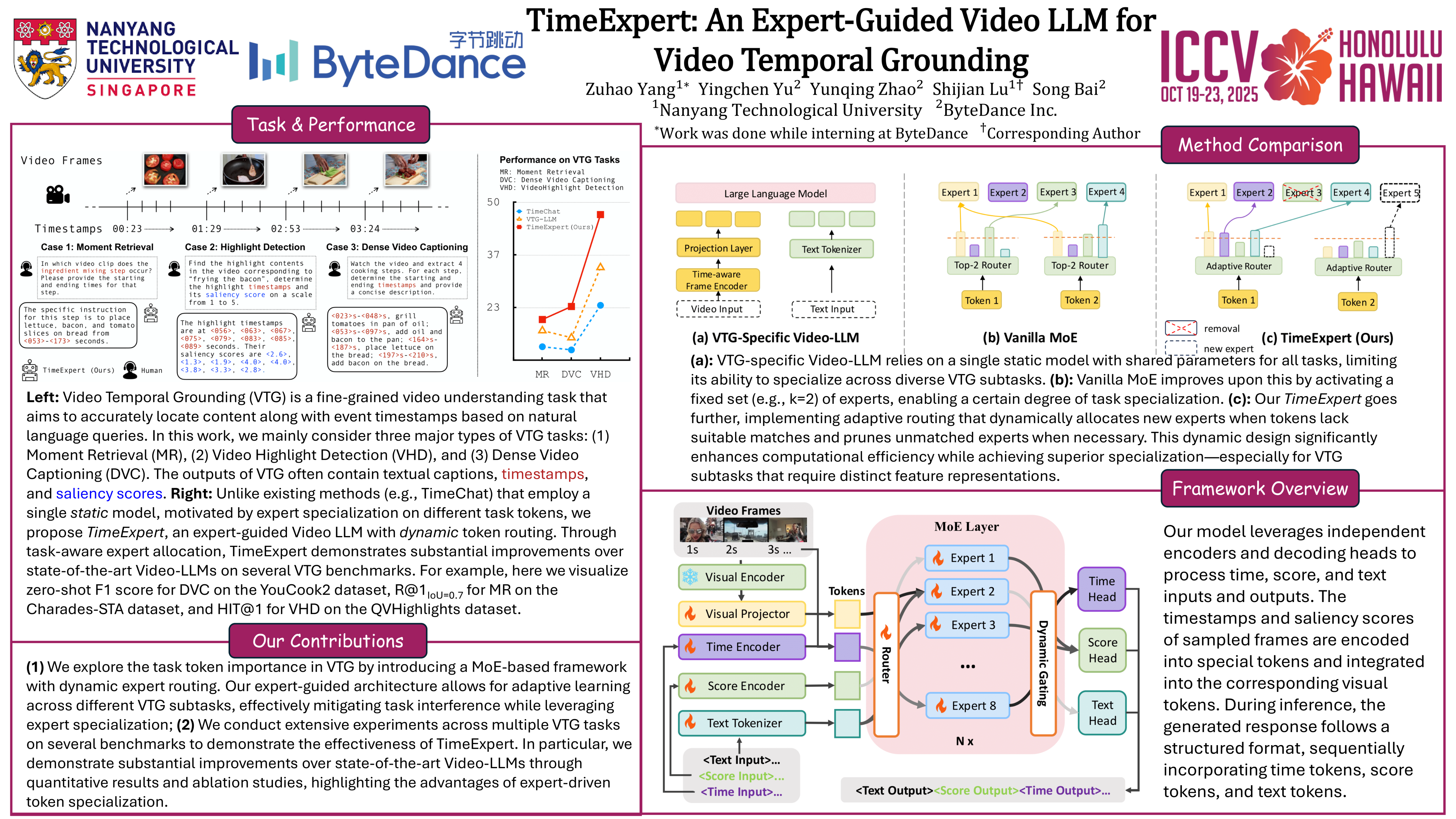
TimeExpert accepted at ICCV 2025.
2024-07
Joined TikTok / ByteDance Singapore as research scientist after receiving PhD from SUTD.

Publications

corresponding  ·  * equal contribution  ·  Full list on Google Scholar

CodeDance
CVPR 2026
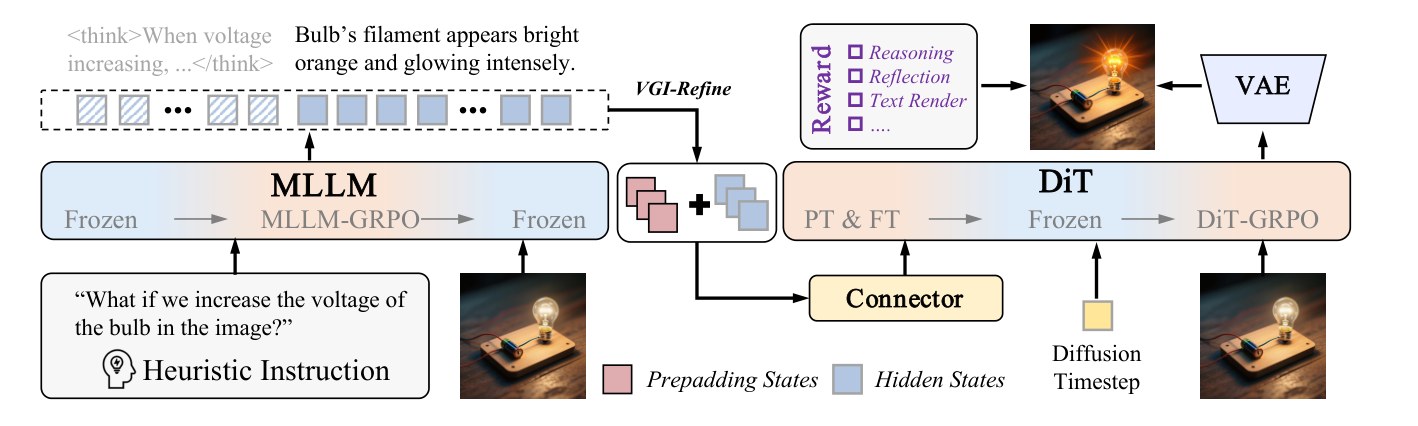
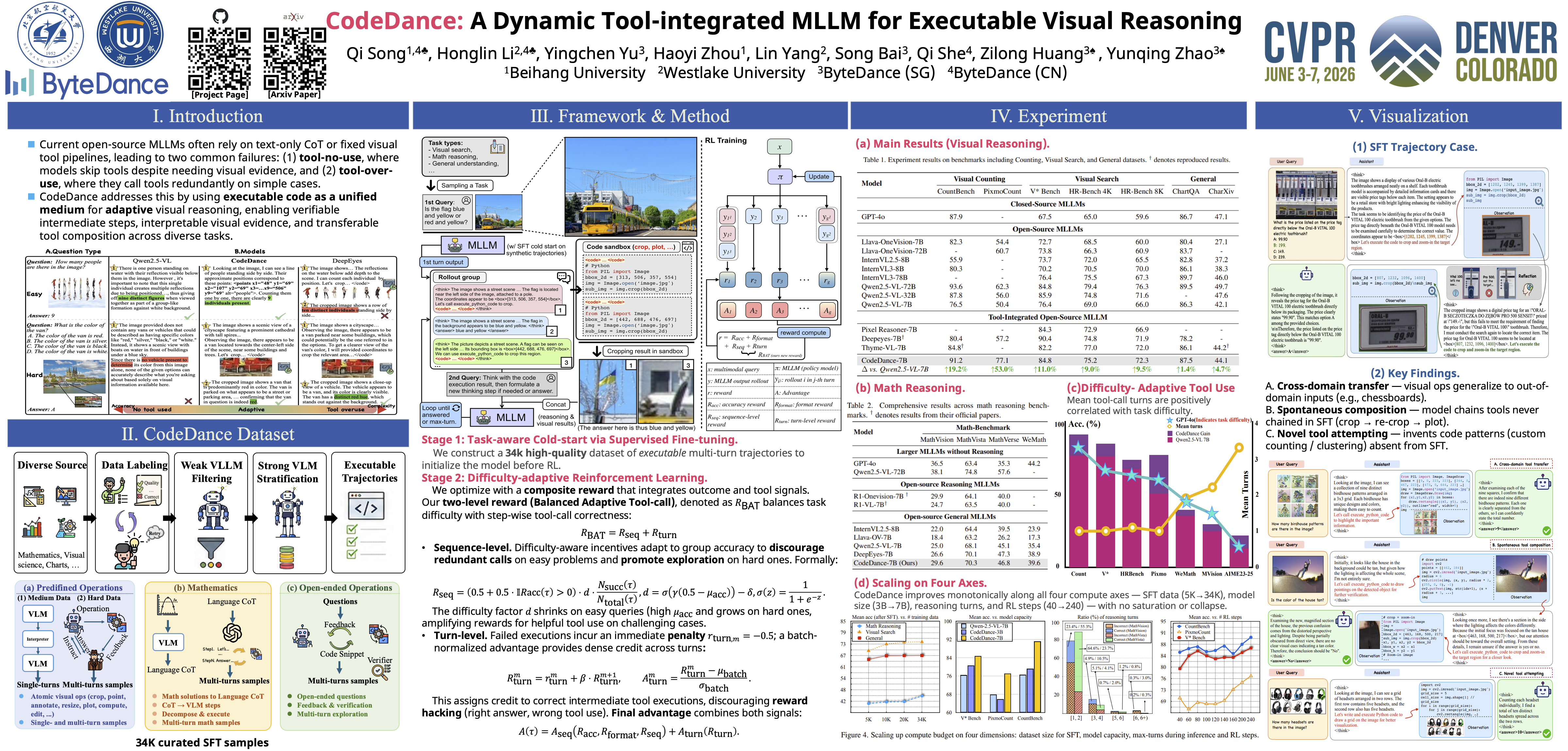
CodeDance: A Dynamic Tool-integrated MLLM for Executable Visual Reasoning
Qi Song*, Honglin Li*, Yingchen Yu, Haoyi Zhou, Lin Yang, Qi She, Song Bai, Zilong Huang, Yunqing Zhao
Do we always need to integrate tools for visual reasoning? While tool-augmented MLLMs have shown strong gains, indiscriminate tool invocation results in unnecessary computation and reasoning inefficiency. CodeDance learns when and how to use tools — and critically, when tool invocation is unnecessary. Through a difficulty-aware RL objective (RBAT), it achieves strong improvements across counting, chart QA, and visual search/math benchmarks while reducing reasoning turns.
TimeExpert
ICCV 2025
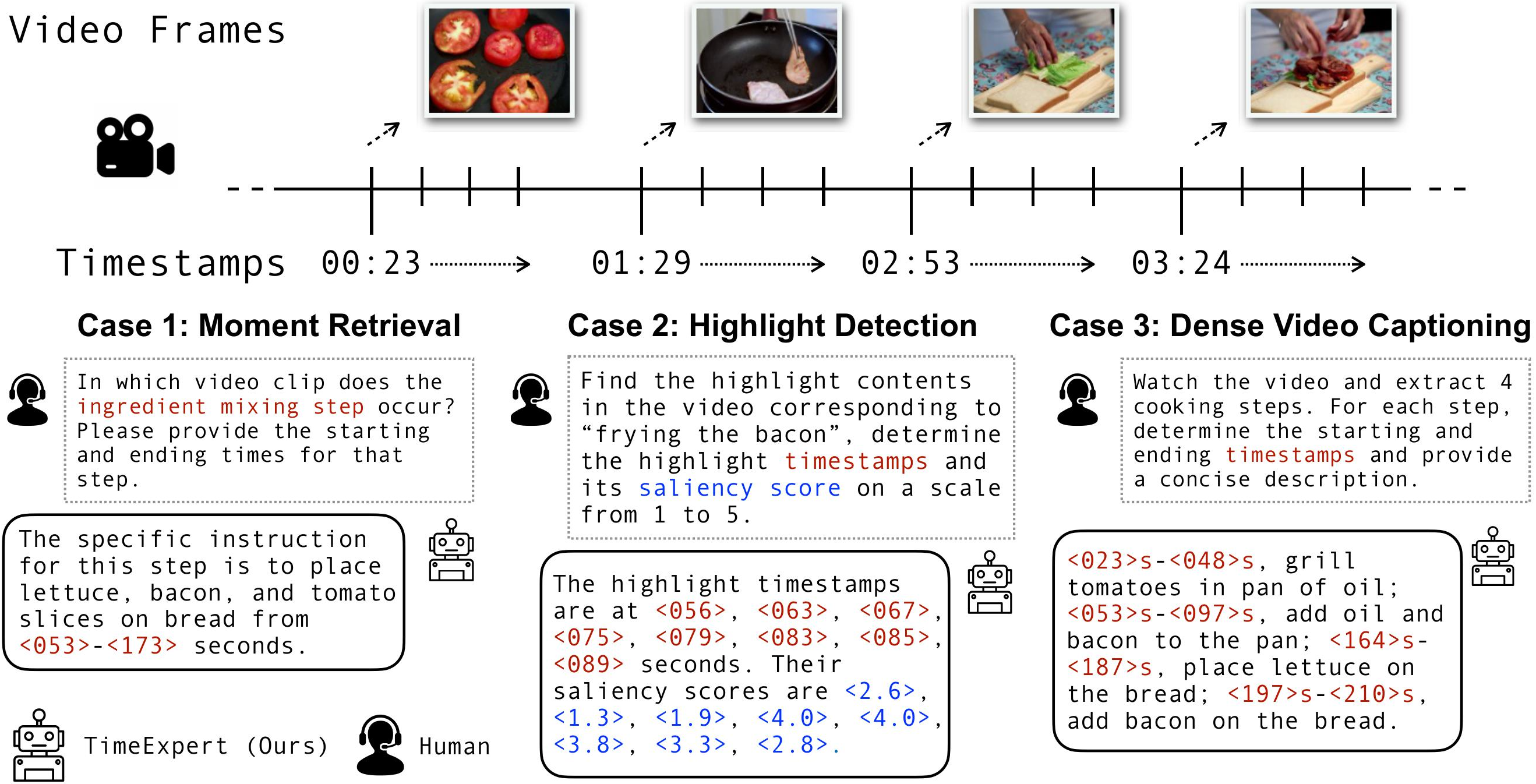
TimeExpert: An Expert-Guided Video LLM for Video Temporal Grounding
WatermarkDM
arXiv 2023 · US Patent 2024
A Recipe for Watermarking (Multimodal) Diffusion Models
We derive a recipe for efficiently watermarking state-of-the-art diffusion models (e.g., Stable Diffusion), via training from scratch or fine-tuning. Our recipe is straightforward but involves empirically ablated implementation details, providing a solid foundation for future research on watermarking DMs.
AttackVLM
NeurIPS 2023
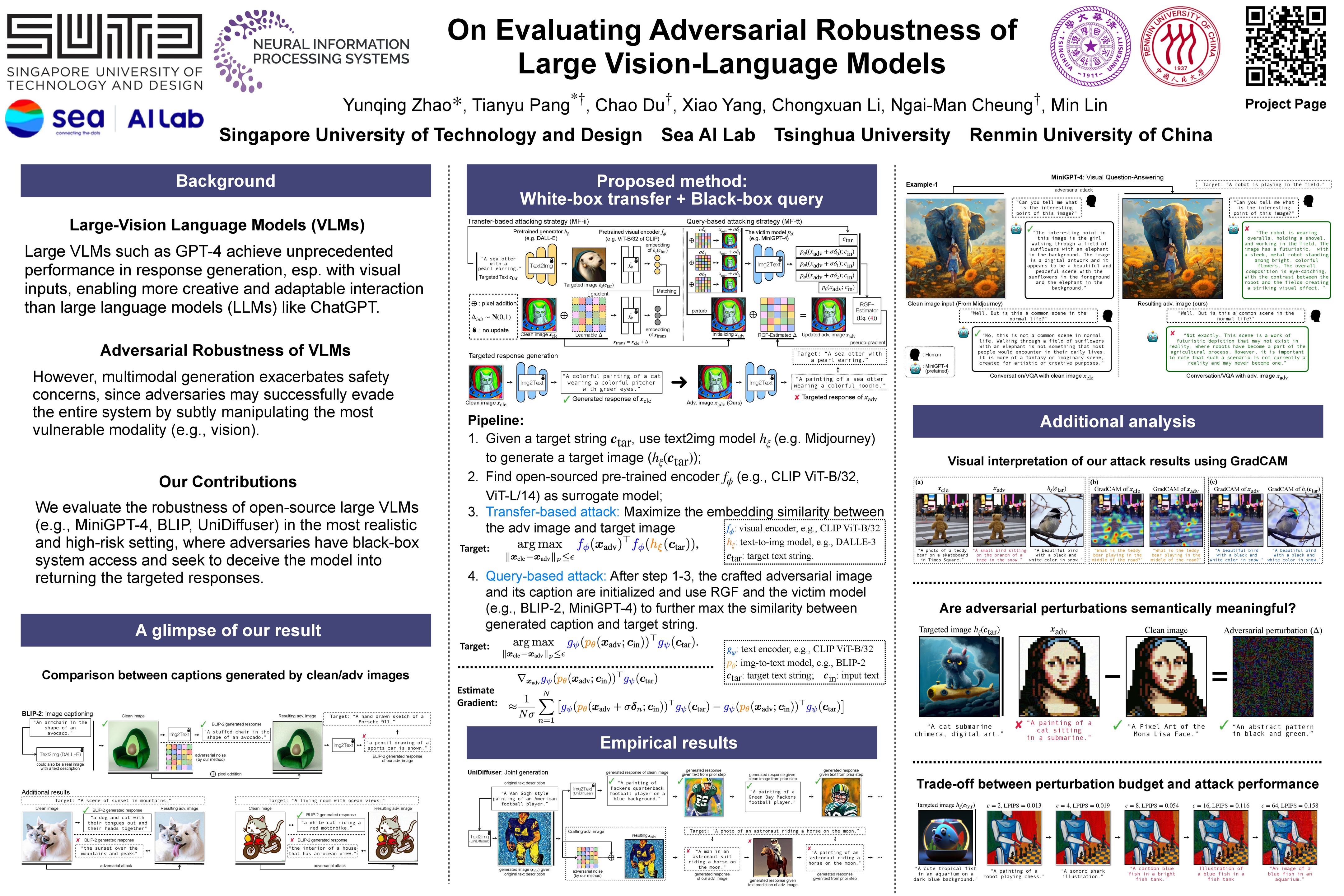
Evaluating Adversarial Robustness of Large Vision-Language Models
Large VLMs achieve unprecedented performance with visual inputs, but multimodal generation exacerbates safety concerns. We evaluate the adversarial robustness of open-source VLMs (e.g., MiniGPT-4, LLaVA, BLIP, UniDiffuser) in the most realistic high-risk setting, where adversaries have only black-box access and seek to elicit targeted responses.
RICK
CVPR 2023
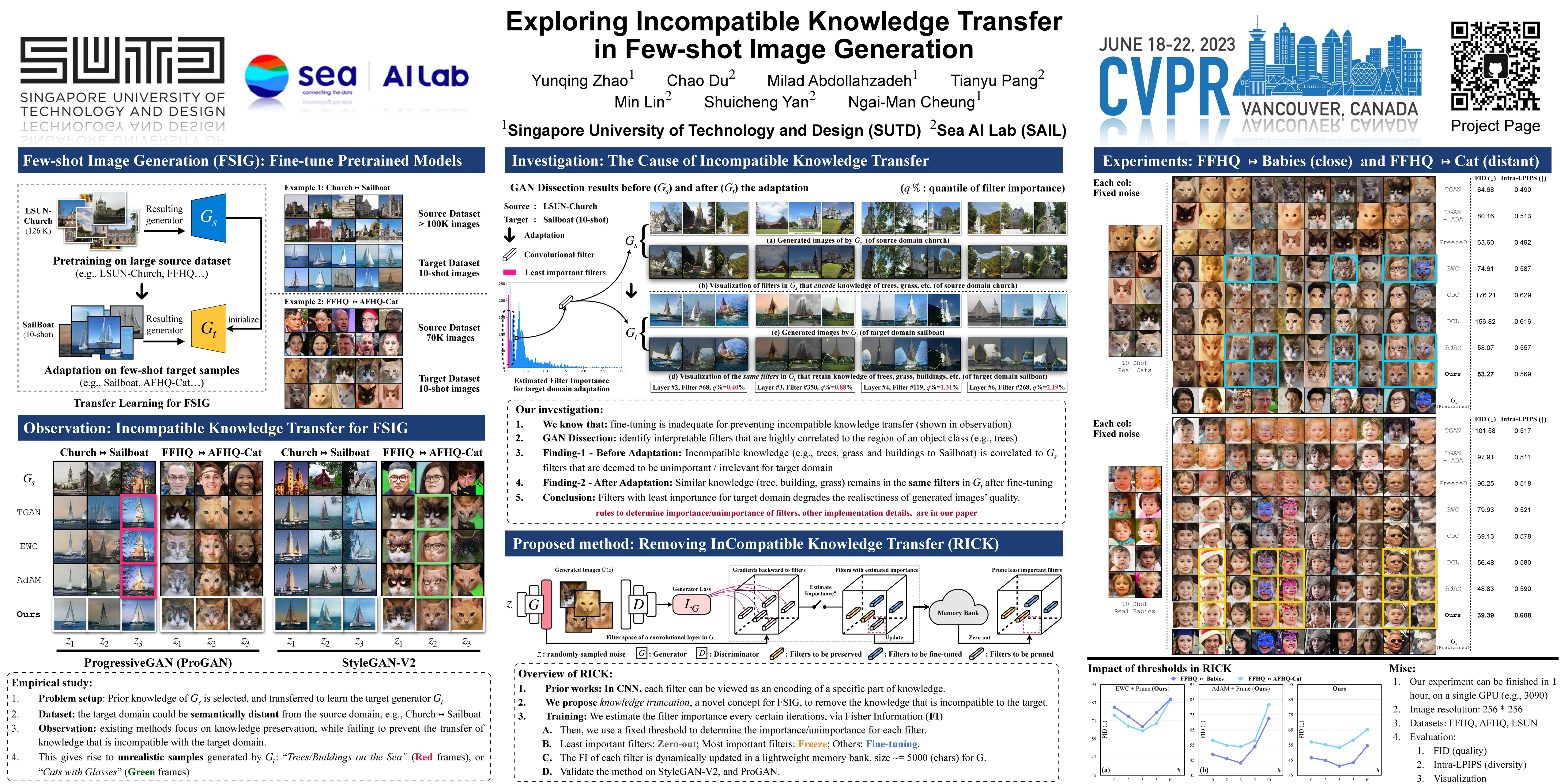
Exploring Incompatible Knowledge Transfer in Few-Shot Image Generation
Through interpretable GAN dissection, we show that fine-tuning-based methods cannot effectively remove knowledge incompatible with the target domain after adaptation. We propose RICK, an efficient algorithm that estimates filter importance and prunes those incompatible with the target domain for few-shot image generation.
FS-BAN
IEEE TIP 2023
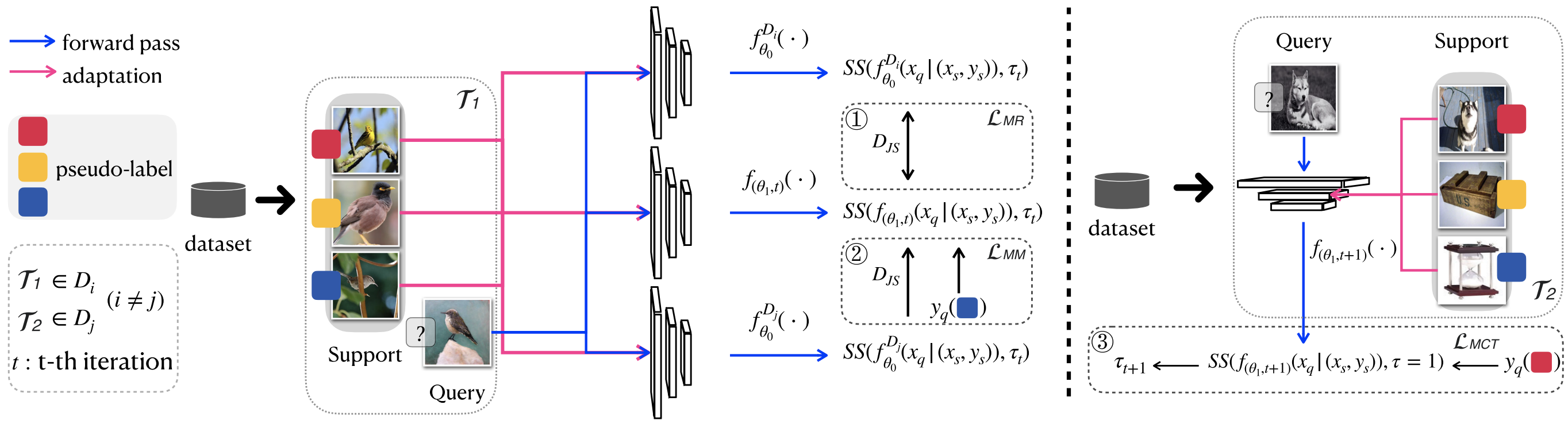
FS-BAN: Born-Again Networks for Domain Generalization Few-shot Classification
Yunqing Zhao, Ngai-Man Cheung
We propose a method to improve generalizability for cross-domain few-shot classification using born-again networks. Our algorithm requires no additional parameters or training data and can be readily applied to existing FSC models, distilling dark knowledge from a teacher via multi-task objectives designed for cross-domain few-shot learning.
AdAM
NeurIPS 2022
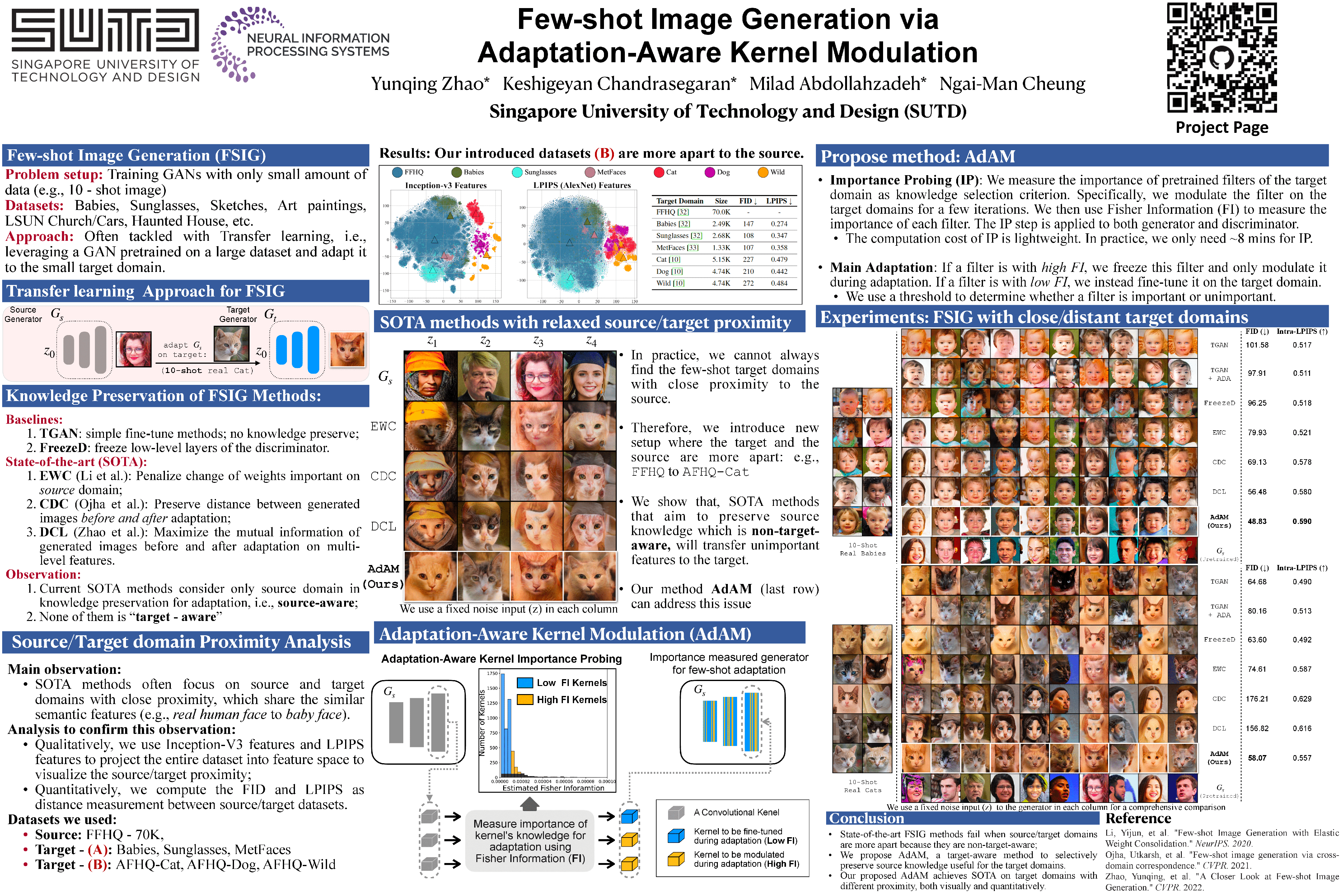
Few-Shot Image Generation via Adaptation-Aware Kernel Modulation
When fine-tuning a pretrained generator on few-shot target samples, we show that state-of-the-art algorithms perform no better than a simple baseline when the target is distant from the source domain. We propose AdAM, a parameter-efficient and target-aware method to select source knowledge important for few-shot adaptation.
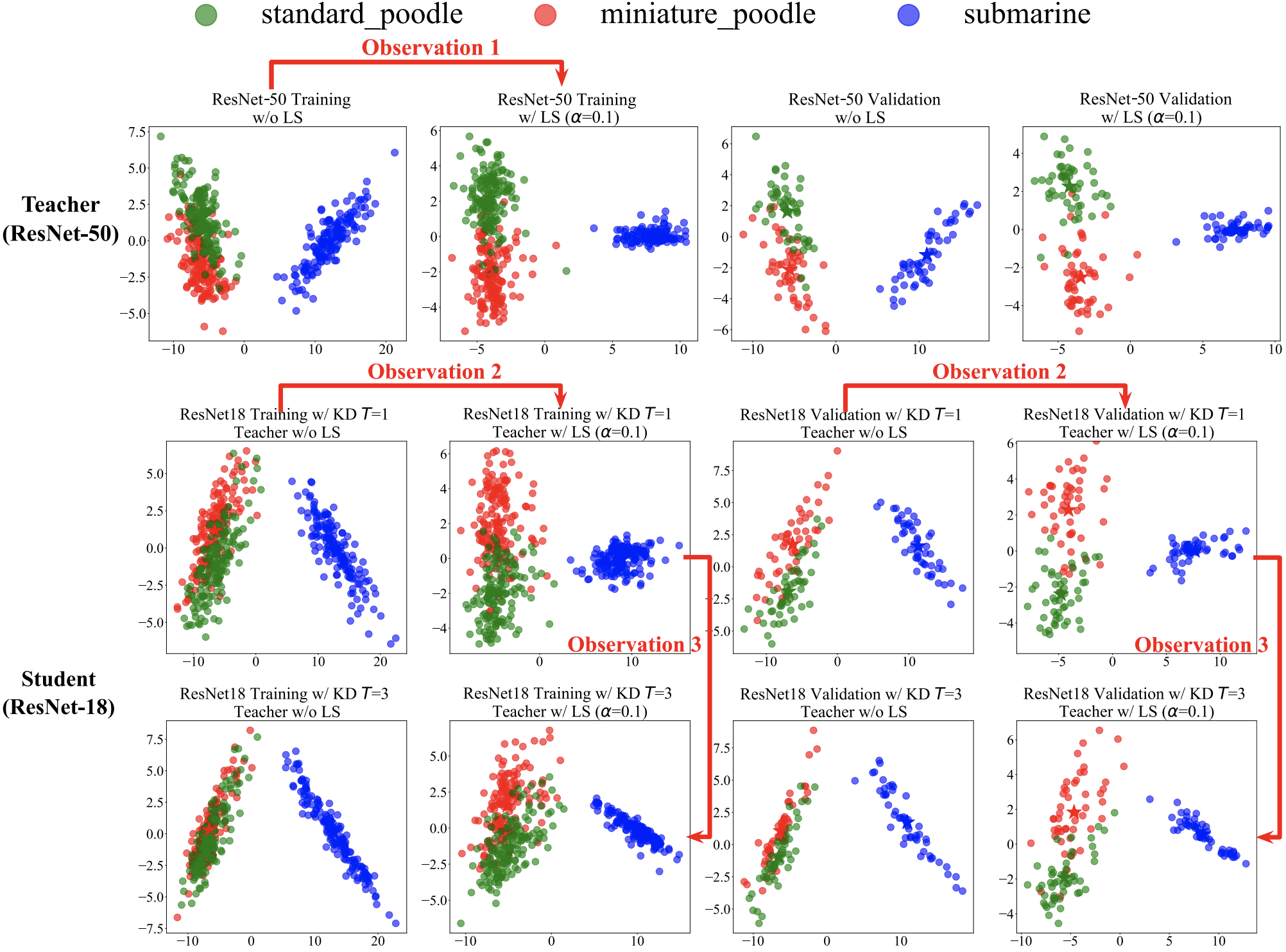
LS-KD
ICML 2022
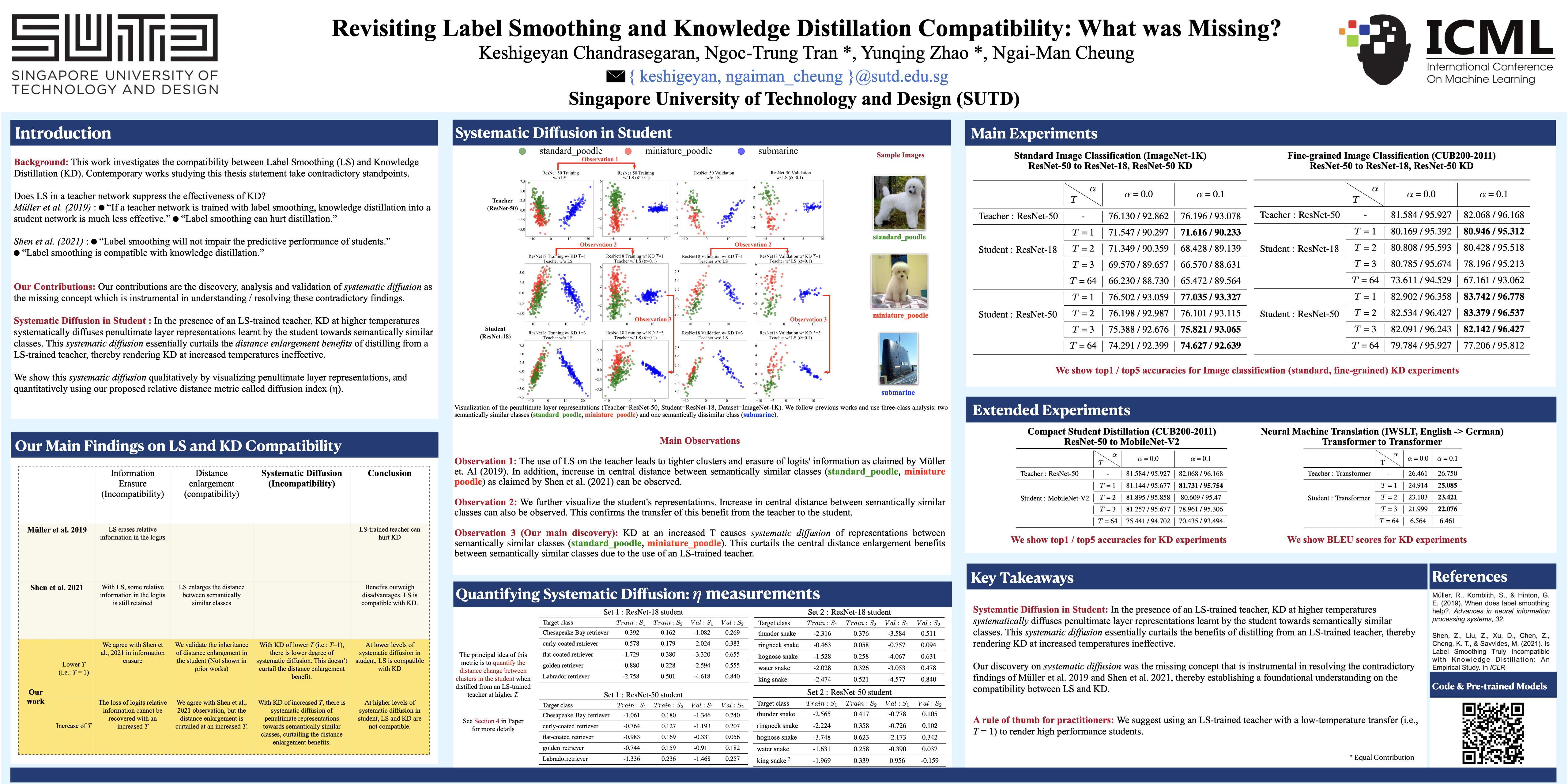
Revisiting Label Smoothing & Knowledge Distillation Compatibility: What was Missing?
FSIG
CVPR 2022
A Closer Look at Few-shot Image Generation
We analyze existing few-shot image generation algorithms in a unified testbed and find that diversity degradation is the major issue during few-shot target adaptation. Our mutual information based algorithm alleviates this issue and achieves state-of-the-art performance on few-shot image generation tasks.

Experience

TikTok / ByteDance, Singapore
Research Scientist  ·  Jul 2024 – Present
Microsoft Research Asia
Research Intern  ·  Nov 2023 – Feb 2024
Sea AI Lab (SAIL), Singapore
Research Intern  ·  Sep 2022 – Nov 2023
TikTok / ByteDance AI Lab, Singapore
Research Intern  ·  Aug 2021 – Aug 2022
ST Engineering – SUTD Cyber Security Lab
Student Researcher  ·  Aug 2020 – Jul 2021
University of Hong Kong
Research Assistant  ·  Nov 2018 – Apr 2019
Advised by Dr. Vincent Tam.

Teaching & Service

Reviewer — NeurIPS, CVPR, TPAMI, TIP, TIFS, TNNLS, TASL, TMM, TCSVT, CVIU.
Teaching Assistant50.021 Artificial Intelligence and 50.035 Computer Vision at SUTD.